
We understand the allure of a 5-year plan. It gives us a sense of direction and control. We draw the contours of the plan and, we hope, the shape of our future.
But what happens when life doesn’t go according to plan? And what happens when it does, and you still don’t like where you landed?
In my years coaching people through career transitions, I’ve rarely seen a 5-year career plan fail for lack of discipline. It fails because it was built for a future that holds still. What holds up better is a personal career compass.
What Happens When a 5-Year Plan Falls Apart?
In half a decade, life will change in ways you can’t predict. Relationships shift. Families grow or fracture. Finances and health rise and fall. New life emerges, unexpected losses arrive, doors open and close.
We tend to treat this kind of upheaval as the exception, the storm that interrupts the calm. But research suggests this weather is actually the norm.
Consider the work of Bruce Feiler. For his Life Story Project, Feiler collected over 1,000 hours of transcripts recording the life stories of people across the United States. What he found is that the average person spends roughly half of their adult life in some state of transition. The linear life of one home, one path, and one job is a relic. In its place are dozens of smaller disruptions and the occasional major “lifequake” that resets everything.
If that’s true, then a 5-year plan isn’t a map of your future. It’s a snapshot of what you wanted on the day you drew it. And when life inevitably diverges, the plan stops offering comfort and starts manufacturing frustration. Perfectly good circumstances begin to feel like failures, simply because they aren’t the plan.
The real danger isn’t that the plan breaks. It’s that we don’t know how to pivot when it does. Take the paralegal from a family of lawyers who took the Bar exam twice a year for twenty years, simply because becoming a lawyer was “the plan.”
When the Plan Works but the Career No Longer Fits
But what about when the plan doesn’t break? When you hit every milestone exactly as designed?
A plan that works can quietly cost you more than one that fails. Consider the MBA graduate and high-powered consultant at a prestigious firm who looked up one day and realized that succeeding there was incompatible with succeeding as a husband and father. The plan was working. That was the problem.
Another client described the same disillusionment after things went exactly to plan:
“My professional life has always been an important part of my identity. I made my plan so that I could do away with career uncertainty. I thought very hard to create the plan so that I didn’t have to think. I could just execute. But it meant disregarding any new information that might disrupt my plans, including ignoring my intuition and my needs. I never considered the toll of abiding by my plan. Despite over a decade of meeting every milestone, I was deeply unhappy.”
This is the hidden trap of the plan-and-execute strategy: it asks you to stop listening to yourself. Your energy, your values, the quiet signal that something is off. A rigid plan treats all of it as noise.
Feiler calls this “the most suffocating iron cage of all,” the belief that each of us must follow a linear career, lock into a dream early, always climb higher, and never stop until we reach the top. “Few ideas have squandered more human potential,” he writes.
Either road is likely to exact a cost. Set a rigid plan and watch life disrupt it. Or hold the plan together through sheer will, and risk arriving somewhere that no longer fits who you’ve become.
What the 5-year plan lacks is not better forecasting or firmer resolve. It lacks something steadier underneath: a set of lasting principles to navigate by when the plan breaks, and to measure against when it doesn’t.
Don’t Hold Your Breath: Why Certainty Isn’t the Goal
The 5-year plan promises certainty and control. But look closer, and those are only stand-ins for what we actually want: peace and ease as we move into an unknown future.
Here’s the uncomfortable part. The surest path to that peace may be to stop chasing certainty altogether. Katherine May puts it this way in her book Wintering:
“As I walk, I remind myself of the words of Alan Watts: ‘To hold your breath is to lose your breath.’ In The Wisdom of Insecurity, Watts makes a case that always convinces me, but which I always seem to forget: that life is, by nature, uncontrollable. That we should stop trying to finalize our comfort and security somehow and instead find a radical acceptance of the endless, unpredictable change that is the very essence of this life. Our suffering, he says, comes from the fight we put up against this fundamental truth.”
Radical acceptance is the destination. But if releasing your grip on the future feels out of reach right now, you don’t have to leap there in one step.
You can still have a strategy for moving forward, just one without the rigidity, the frustration, and the risk of getting stuck. You need something to navigate by. A trustworthy guide for meeting uncertainty with confidence.
You need a compass.
What Is a Personal Career Compass?
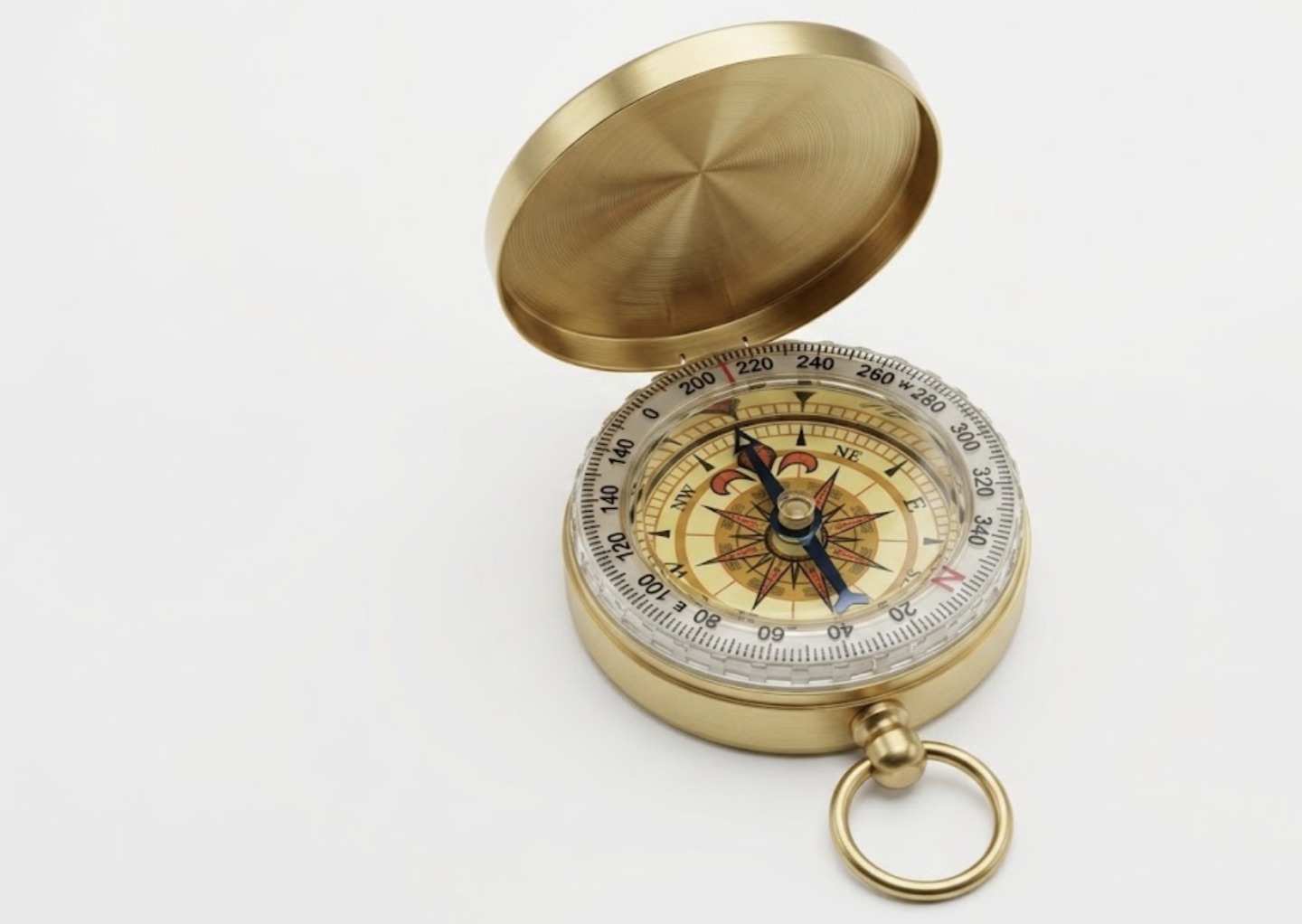
You know how a compass works. It’s a simple tool that points you toward where you want to go. It stays steady and dependable, and it’s your reference point when you feel lost.
A Career Compass works the same way. It’s a dynamic tool for navigating your professional life and any career transition, giving you a true north to orient by. Unlike a plan, it holds up when circumstances change, because it’s grounded in who you are, not where you happen to be. Your compass is deeply personal, defined by your innate design, your needs, and your core values.
A plan asks, “Where will I be in five years?” A compass asks something you can actually answer today: “Does this next step move me in the right direction?” You can ask that on the day you’re laid off or the day you’re offered a promotion. In a place like the Bay Area, where one reorg can rewrite your job description overnight, that kind of steadiness counts for a lot.
How to Build Your Career Compass
Start with who you are
Start with who you are, fundamentally. What energizes you? Engages you? Motivates you? Which moments in your professional life were the bright spots you’d love to recreate, the times you felt you were doing your best, most meaningful work? This is what points you toward true alignment.
Then decide what matters to you
Then turn to what matters to you. How will you define success? Who do you want to become, and what kind of environment will help you grow into that person? What are your non-negotiables, the things you won’t trade away? This is what ensures every choice gets measured against your chosen standard.
Test it on a real career decision
A compass only earns its keep when you use it. Say a recruiter calls about a role with a bigger title and a longer commute. A plan asks whether the title fits your timeline. Your compass asks different questions. Does the work draw on your strengths? Does the culture respect your values? Does it move you toward the person you said you want to become? If most of the answers are no, you have your decision, and you can make it without weeks of second-guessing.
The more honestly you invest in this work, the more faithfully your compass will reflect who you are and what you value, and the more ease you’ll feel with each career decision.
Should You Still Set Career Goals?
Yes. A compass doesn’t ban goals. It gives them something to answer to. Set the goal, then check it against your compass every so often. If a goal no longer points toward your true north, letting it go is a course correction, and your compass is what tells you one is due.
Build Your Compass With Career Compass
If you’d like structured support building your compass, that’s exactly what my online course, Career Compass, is for. It’s self-paced and walks you through the work described above: what engages you, your strengths, your core motivation, your values, who you want to become, and how you define success. You finish with a complete compass you can come back to whenever a career decision comes up.
Janelle Carter took the course while at a crossroads after several years in residential real estate that followed a career in education. Here’s how she described it:
"Career Compass helped me step back and think more intentionally about what actually matters to me in my work... The process helped me approach my career assessment with more clarity about the kind of work and work culture that will allow me to do my best and most meaningful work."

Confidence and clarity await.
You can get Career Compass here.
It is also Method 01 of The Re-Design Method, my complete career transition system. If you already know you want a career change, The Re-Design Method helps you build clarity, choose a direction, and land the role.
If you rather work through it one-on-one, many of my career coaching clients start with Career Compass and bring their first draft to a coaching session.
Brandy DeOrnellas is a Professional Certified Coach (PCC), Harvard Law grad, and former attorney based in the San Francisco Bay Area. She works with individuals navigating career transitions, career growth, and life design through 1:1 coaching, team coaching, and online courses.
© Life By Design Coaching LLC · bdeornellas.com






Comments +