

I was standing in the kitchen on an ordinary weeknight. My toddler was crying. My five-year-old was asking for more ketchup. And my husband wanted to know where I’d put the cheese grater for the pizza he was making.
None of this was unusual. This is the soundtrack of our evenings. But moments like these had become deeply uncomfortable, even unbearable. Heart racing, total overwhelm, and the urgent need to get away. My body freaks out – and then I do.
In the moment, I’d tried to reason with myself – You’re in your kitchen with your family. There’s no emergency. You’re safe. But it didn’t help. I was responding to emotion with logic, pitting my mind against my body.
It turns out that I didn’t need a mindset shift. It wasn’t a failure of will; it was nervous system dysregulation. I’ve since learned that you can’t think your way out of a physiological overflow—you have to regulate your way out. This distinction changed everything about how I relate to myself in hard moments, and how I coach others through theirs.
What Is Your Nervous System, Anyway?
Your nervous system is your body’s primary control center. It governs your heartbeat, breathing, digestion, sleep, mood, and ability to feel safe. The part that matters most for our purposes is your autonomic nervous system, which has two modes:
- The sympathetic nervous system: your accelerator – fight-or-flight system
- The parasympathetic nervous system: your brake – governed by the vagus nerve, your system for recalibration and safety.
In a healthy state, these work like a seesaw. Challenge comes, accelerator engages. Challenge passes, brake kicks in. The problem is that many of us are living with the accelerator floored and the brake barely functioning.
This is nervous system dysregulation – your body chronically stuck in stress mode, even with no immediate threat.
Evaluate Your Nervous System
So how do you know when your nervous system is dysregulated?
In the book Heal Your Nervous System by Dr. Linnea Passaler, she offers a practical tool she calls the Alertness Elevator – a map of the different states of arousal your body moves through in response to life’s demands.
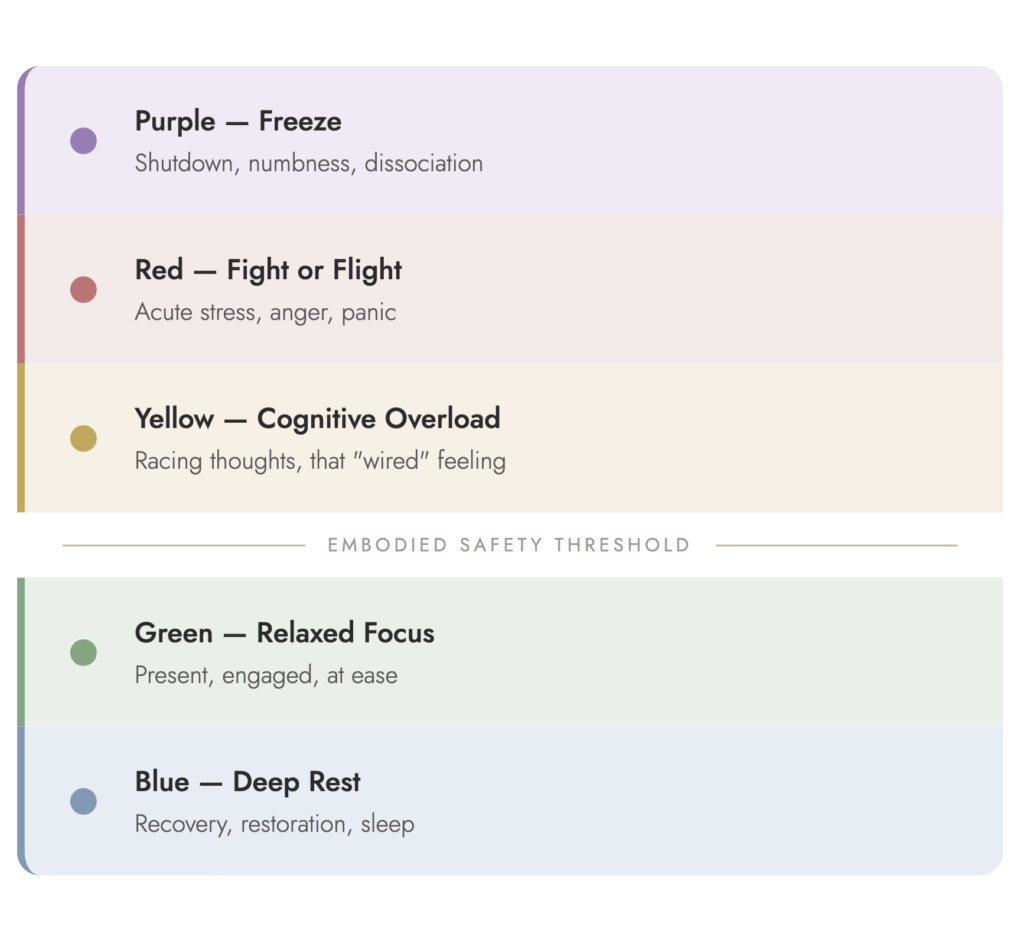
Passaler writes: “The key to a healthy nervous system lies in its flexibility, not balance.” Visiting Red or Yellow isn’t the problem. Getting stuck there is.
When we get stuck, it’s not always obvious (like emotional melt downs or panic attacks). More often, it’s symptoms we’ve learned to explain away:
- Difficulty sleeping, even when exhausted
- Hypervigilance – bracing for something bad to happen
- Chronic muscle tension in your jaw, neck, or shoulders
- Brain fog or difficulty concentrating
- Digestive issues or appetite changes
- Emotional reactivity – snapping or crying at small provocations
- Fatigue that rest doesn’t resolve
- Numbness or emotional flatness
- Overwhelm from stimuli that didn’t used to bother you
- Overworking or overproducing as a way to feel in control
If you’re feeling overwhelmed or experiencing these symptoms, don’t be discouraged. Now that you know what’s happening, you can take action to care for your nervous system.
Restore Your Nervous System
Here’s a metaphor from Dr. Passaler’s book that has changed the way I think about stress – and about what it actually takes to protect ourselves from dysregulation.
Imagine you’re carrying a cup. The cup is your nervous system’s capacity – how much it can hold before things spill over. The water is everything flowing in – the demands on your nervous system. Work, relationships, poor sleep, mental load, the news. Drip, drip, drip.
When the cup overflows, that’s dysregulation. That’s the moment your nervous system gets overwhelmed and stops functioning properly. Most of us only pay attention to the final drop that created the spill – without realizing that the cup was already at the brim.
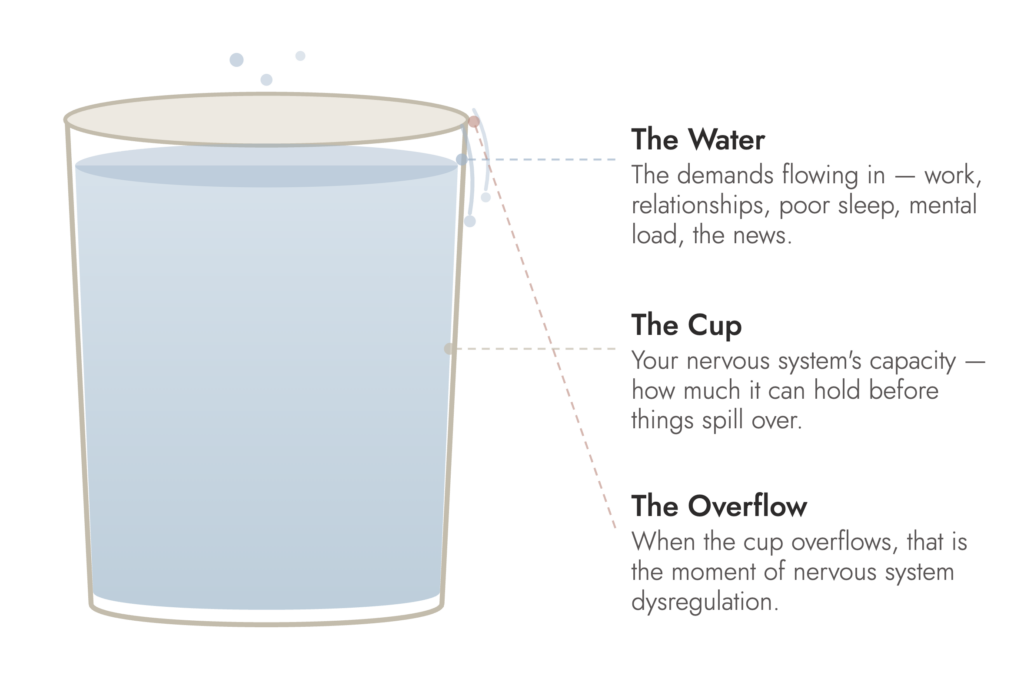
What I love about this metaphor is that it gives us two clear levers – two concrete strategies for protecting our nervous system. The rest of this article is organized around them:
- Lever 1: Reduce the water. Lower the demands on you so the cup stops filling so fast.
- Lever 2: Expand the cup. Increase your capacity so it can hold more before it overflows.
The goal is not to eliminate stress. The goal is to stop living at the brim. And it begins by asking: Do I need to turn down the flow, or do I need to build a bigger container?
Lever 1: Reduce the Water
This lever is about lowering the demands that flow into your system so your cup isn’t constantly filling. Dr. Passaler dedicates an entire chapter of her book to the role of structure and predictability in nervous system health, noting that these elements help a dysregulated nervous system feel safer and more relaxed. In my coaching practice, I’ve seen this play out again and again: the clients who make the most progress are dedicated to the rhythms they need to rest, recover, and thrive.
Method No. 1: Build Downtime Into Your Lifestyle
Not as an afterthought. Not as the thing that gets cut when the schedule fills up. Downtime goes on the calendar first – before the meetings, before the deadlines, before the obligations. Because if it doesn’t have a place in your schedule, it won’t have a place in your life.
And I mean real downtime. Not scrolling. Not “productive rest” like organizing your closet or catching up on emails from the couch. Time with no agenda, no output, and no stimulation. Time that allows your parasympathetic nervous system to do its job.
Method No. 2: Create Transitions
One of the fastest ways to keep the cup at the brim is to move from one high-demand activity to the next with no buffer. Your nervous system needs transitions – brief moments of intentional decompression between activities. Five minutes of silence in your car before walking into the house. A short walk between meetings. Three deep breaths before picking up the phone. Micro-pauses are non-negotiable. They are the moments in which your system recalibrates.
Method No. 3: Audit Your Environment
Your nervous system doesn’t just respond to what’s happening to you. It responds to what’s happening around you. The noise level in your workspace. The energy of the people you spend the most time with. The pace at which you move through your day. The volume of news and social media you consume.
Take an honest inventory. What in your environment is adding water to the cup? Where can you reduce stimulation, create quiet, or set a boundary? (If you live with kids, creating a calm, quiet, clutter-free environment can feel like an impossibility. Thankfully there are noise-cancelling headphones – and five other methods!)
Lever 2: Expand the Cup
Remember the Alertness Elevator? Dr. Passaler shares a salient insight that is crucial for regulation. You can move from Red to Yellow by managing and changing your thoughts. But to move from Yellow to Green requires feeling safe – something Dr. Passaler calls “embodied safety.”
In other words, to experience a truly calm nervous system requires a physical experience of safety, not a logical argument. To expand the cup, you need practices that speak to your body in a language it understands.
Method No. 4: Honor Your Body’s Basics
Sleep, sunlight, movement, nourishment – what Dr. Passaler calls the biological foundations of regulation. Morning sunlight calibrates your circadian rhythm. Consistent sleep restores your system. Movement discharges accumulated stress. Eating consistently prevents the blood sugar crashes that your nervous system reads as emergencies. These aren’t luxuries – they’re the raw materials needed to build capacity for life.
Method No. 5: Seek Out Safe People
We are social creatures, and our nervous systems were never meant to regulate in isolation. The science of co-regulation tells us that being around calm, safe people – a partner’s steady presence, a friend’s unhurried conversation, even a pet beside you – physiologically lowers your heart rate and stress levels. Over time, these safe relationships expand the cup by building your system’s baseline capacity for connection and trust.
Method No. 6: Practice Somatic Resets
Dr. Passaler describes these body-based interventions as gateways that bypass the thinking brain and signal safety directly to the nervous system. Every time you use one, you’re not just calming down in the moment – you’re building new neural pathways. You’re expanding the cup. Here are three you can use anywhere:
The Physiological Sigh. Two quick inhales through the nose, one long exhale through the mouth. Research shows this is one of the fastest ways to activate your parasympathetic (rest and recovery) system. It takes ten seconds. You can do it in a meeting, in traffic, before a hard conversation.
The Basic Exercise. Interlace your hands behind your head and slowly move your eyes to the far right, then the far left, until you feel a spontaneous yawn or swallow. That involuntary response is your vagus nerve resetting – your body’s way of shifting from alert to safe.
Humming or Singing. Your vocal cords are directly connected to the vagus nerve. Vibrating them through humming, chanting, or singing sends a direct signal to shift from fight-or-flight to rest-and-digest. If you’ve ever felt calmer after singing in the car, now you know why.
Other options include: hugs, relaxing under a weighted blanket, or pursuing soothing sensations, like massage, a warm bath, or the sun on your skin.
Regulation – It’s Worth The Work
If you’re chronically overwhelmed, quick to anger or agitation, or feeling like you’re melting down without much cause, the signals your body sends are not inconveniences to override. They are data. And they may be your nervous system communicating what it needs to function – for you to function.
It takes hard work to build rhythms to nurture your nervous system. It may mean saying no, prioritizing your body or your relationships, or giving yourself regular breaks to just be somewhere quiet. But it’s worth it.
The reward is your agency. You get to show up in all the parts of your life as yourself, without the risk of getting hijacked. You are able to respond to everyday moments with an everyday reaction and to difficult moments with a level-head.
Let’s start simply. Ask yourself often: how full is my cup? And if the answer is “close to the brim,” give yourself permission to set something down.
—
Concepts drawn from Dr. Linnea Passaler’s Heal Your Nervous System: The 5-Stage Plan to Reverse Nervous System Dysregulation (Fair Winds Press, 2024). If this resonated, I’d encourage you to read the full book. Available wherever books are sold.
Note: Nothing in this article is designed to serve as medical advice or to replace the guidance and care of a medical professional. If you are experiencing disregulation or other symptoms described in this article, consider seeking medical advice.







Comments +